
As a growing company, you may have turned to a PEO to simplify HR and ease the burden of payroll, compliance, and benefits administration. For many organizations, this model works well — especially in the early stages. But as your team expands, challenges can surface: rising fees tied to payroll percentages, long onboarding timelines, limited flexibility in systems, and a lack of strategic guidance beyond the basics. These factors often prompt leaders to explore PEO alternatives that provide greater control, transparency, and long-term value.
If you’re actively searching for PEO alternatives that deliver executive‑level HR expertise on demand, predictable pricing, and seamless integration with your existing systems, fractional HR services offer the solution you’ve been missing. If you’re evaluating PEO alternatives or seeking alternatives to co-employment for HR, Fractional HR offers flexibility, cost transparency, and strategy.
PEO vs Fractional HR: The Hidden Downsides of Co-Employment
When scaling a business, HR isn’t just about compliance or payroll, it’s about cultivating culture, building teams, and aligning people strategies with business goals. Many small and mid-sized businesses (SMBs) turn to Professional Employer Organizations (PEOs) for HR outsourcing, only to find themselves locked into expensive, one-size-fits-all models.
That’s where Fractional HR enters as a modern, strategic alternative, delivering executive-level HR expertise on your terms.
The PEO Promise vs. The Real-World Experience
PEOs market themselves as turnkey HR solutions companies, handling payroll, benefits, and compliance through a co-employment model. At first glance, this seems like a relief to busy founders and overwhelmed managers. But beneath the surface, cracks start to show:
1. Co-Employment Confusion: Sharing employer responsibilities with a PEO can erode your autonomy over employee policies, hiring decisions, and workplace culture, creating friction when your vision diverges from their processes.
2. Cost Creep: PEOs typically charge a percentage of your total payroll, so as your headcount grows, HR costs balloon disproportionately, eating into budgets that could be used for strategic initiatives.
3. Tech Lock-In: PEOs often mandate the use of their proprietary HRIS or benefits platforms, which may clash with your existing tech stack, lack customization, or become cumbersome as your company scales.
4. Lack of Strategic Insight: PEOs excel at transactional tasks like payroll and compliance but rarely offer the high-level strategic guidance needed to build leadership pipelines, optimize team dynamics, or align HR with long-term business goals.
5. Hidden Fees and Fine Print: Contracts often bury additional costs, setup fees, termination penalties, or charges for ancillary services, that can catch businesses off guard, especially startups with tight cash flow.
6. One-Size-Fits-All Approach: PEOs tend to apply standardized solutions that may not suit your industry, company size, or unique culture, leaving you with generic policies that fail to engage employees.
7. Employee Experience Disconnect: Since PEOs manage benefits and HR remotely, employees may feel detached from the process, leading to confusion over benefits access or a lack of personalized support.
8. Compliance Overreach: While PEOs promise to handle compliance, their rigid adherence to regulations can stifle flexibility, forcing you into overly cautious policies that hinder innovation or agility.
9. Data Ownership Risks: Using a PEO’s systems means your employee data lives on their platforms, raising concerns about access, security, or portability if you decide to switch providers.
These issues frustrate many business owners who realize they need a more tailored, transparent, and flexible HR approach.
While PEOs do provide value -especially for smaller companies that need immediate help with payroll, compliance, and benefits – it’s not about one model being “better” than the other. It’s about fit. Many businesses find PEOs useful in their early stages, and some continue to benefit from them long term. But as organizations mature and their needs evolve, the limitations of a co-employment model become more apparent. That’s when exploring a PEO alternative like Fractional HR makes sense, offering flexibility, cost transparency, and strategic depth that PEOs typically can’t provide.
Have HR Questions? Let’s Talk
What Is Fractional HR?
Fractional HR companies provide the modern answer for organizations seeking strategic support without the burden of full-time leadership hires. Think of them as a fractional CHRO or strategic HR partner who integrates into your business as needed. Unlike HR outsourcing companies like PEOs, fractional HR companies do not operate under co-employment structures, and they adapt to your workflows, culture, and tools.
PEO vs Fractional HR: 5 Key Advantages
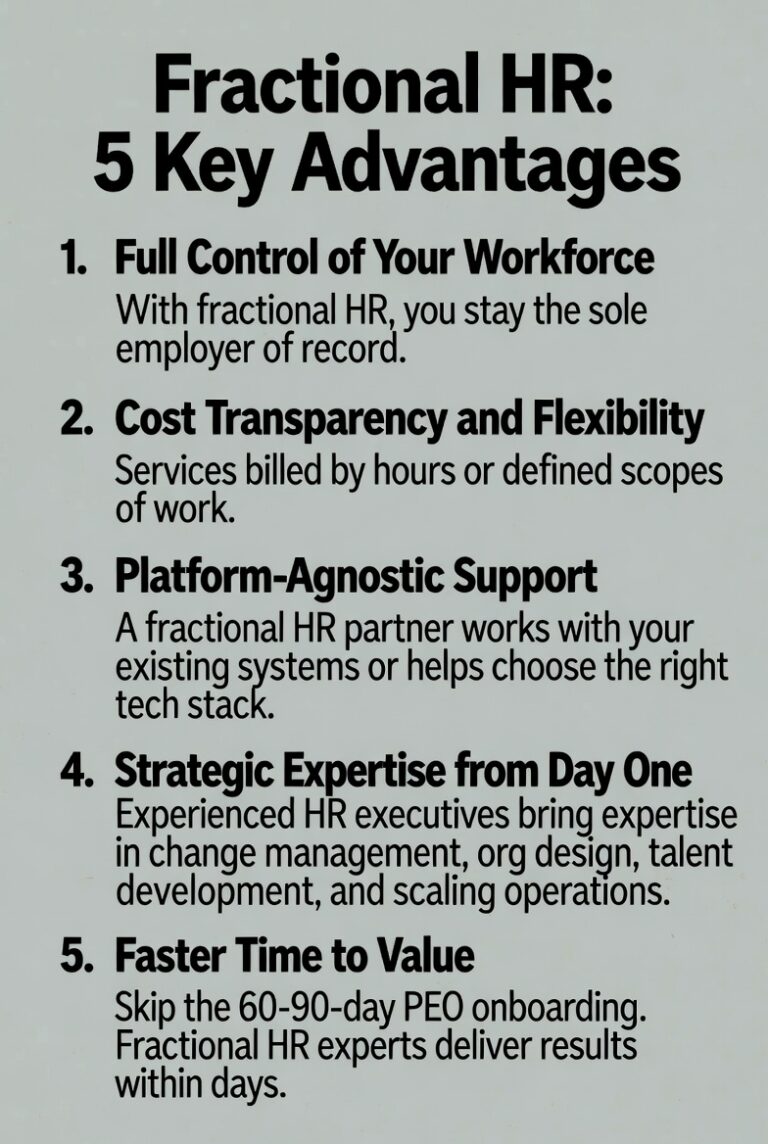
When evaluating a PEO alternative, the biggest differentiator comes down to control, flexibility, and strategy. PEOs may handle payroll and compliance, but their one-size-fits-all, co-employment model often limits customization and drives costs up as you grow.
Fractional HR, on the other hand, provides executive-level HR leadership without the lock-in – adapting to your systems, aligning with your culture, and scaling only as your needs evolve. Below are the core advantages of choosing fractional HR over PEOs for growth-minded businesses.
- Full Control of Your Workforce
With fractional HR, you remain the sole employer of record. You maintain full control over how your policies, culture, and teams are structured and governed. - Cost Transparency and Flexibility
Rather than a fixed percentage of payroll, fractional HR services are priced based on hours or defined scopes of work. You only pay for what you need, with no hidden markups or ballooning costs. - Platform-Agnostic Support
A fractional HR partner works with your current HR systems or helps identify the best tech stack for your unique needs. There’s no pressure to use a proprietary platform. - Strategic Expertise from Day One
Fractional HR pros are seasoned HR executives who bring experience in change management, org design, talent development, and scaling people operations. - Faster Time to Value
Skip the 60-90 days onboarding period required by PEOs. Fractional HR experts can begin adding value within days.
| Feature | PEO (Professional Employer Organization) | Fractional HR (PEO Alternative) |
|---|---|---|
| Employment Model | Co-employment (PEO shares legal employer responsibilities) | You remain the sole employer; no co-employment risk |
| Cost Structure | Typically 3–6% of payroll, plus hidden fees and setup costs | Flexible pricing (hourly, retainer, or project-based); pay only for what you need |
| Control Over Policies & Culture | Limited — PEO policies may override your own | Full control; HR aligns with your unique culture and strategy |
| Technology & Systems | Must use PEO’s proprietary HR/payroll/benefits platform | Platform-agnostic; works with your existing systems or helps you choose the right stack |
| Strategic Support | Transactional focus (payroll, compliance, benefits) | Executive-level HR leadership (org design, talent strategy, culture, DEI, leadership development) |
| Onboarding Timeline | 60–90 days before you’re fully integrated | Days to weeks; faster ramp-up and immediate impact |
| Scalability | Costs increase as headcount grows; inflexible contracts | Scales with business needs; no lock-in |
| Customization | One-size-fits-all policies and processes | Tailored HR solutions built around your industry, size, and growth goals |
| Employee Experience | Benefits and HR managed externally; may feel disconnected | Employees receive more personalized, company-aligned HR support |
| Data Ownership | Employee data stored in PEO systems; portability concerns | Data stays with you; full transparency and control |
Real-World Example: Tech Firm Breaks Free from PEO
A mid-sized SaaS company with 80 employees had been using a PEO for over two years. Frustrated by mounting costs, limited control, and inflexible technology, they explored Fractional HR. Within six months:
1. They cut HR costs by 38%
2. Launched an internal leadership development program
3. Increased employee satisfaction scores by 22%
4. Aligned performance management with EOS (Entrepreneurial Operating System)
The switch gave them not only savings, but strategic HR capacity they never had with a PEO. This SaaS firm illustrated why many growth-stage companies choose fractional HR as their preferred PEO alternative.
Book a Free Consultation with Our HR Specialists
Why PEOs No Longer Fit Today’s Growth-Minded Businesses
Any business, be it small and medium-sized businesses (SMBs) prioritize speed, flexibility, and control to stay competitive. Professional Employer Organizations (PEOs) promise streamlined HR through co-employment, focusing on payroll, benefits, and compliance.
While this standardized approach ensures regulatory adherence, it often sacrifices strategic depth, leaving growth-minded companies underserved. PEOs’ rigid systems and one-size-fits-all solutions struggle to align with the dynamic needs of modern businesses, which demand tailored, people-centric HR strategies.
Today’s SMBs require HR leaders who can act as strategic partners: coaching executives to navigate leadership challenges, designing performance management systems to drive accountability, fostering inclusive cultures through robust DEI initiatives, and leveraging people analytics to optimize talent and predict workforce trends. PEOs, tethered to transactional tasks and proprietary platforms, rarely deliver this level of insight or adaptability. Their cost structures, often tied to payroll percentages, can also strain budgets as companies scale.
Fractional HR services offer a compelling alternative, providing access to seasoned HR experts who integrate seamlessly with your team. These professionals deliver customized strategies without the lock-in of inflexible PEO systems, empowering businesses to stay agile, strategic, and focused on growth in a people-driven market.
How to Transition from a PEO to a Fractional HR
Transitioning away from a Professional Employer Organization (PEO) takes planning. To keep your business compliant and running smoothly, it helps to follow a clear, step-by-step approach.
Here’s a practical guide to make the shift easier.
1. HR Audit & Roadmap: Conduct a comprehensive audit of your current HR systems, processes, and compliance gaps. Evaluate payroll, benefits, and employee policies to identify inefficiencies or misalignments. Develop a roadmap prioritizing short-term fixes and long-term people strategies tailored to your growth goals.
2. Fractional Leader Engagement: Engage a fractional HR expert to provide high-level guidance. These seasoned professionals can assess your needs, coach executives, and build internal HR capabilities, ensuring a strategic foundation without the overhead of a full-time hire.
3. Platform Optimization: Research and select HR tools that align with your business objectives. Choose scalable solutions for applicant tracking, payroll, benefits administration, or employee engagement that integrate with your existing tech stack and support future growth.
4. Knowledge Transfer: Document all PEO-managed processes, policies, and data. Work closely with the PEO to transfer critical knowledge, such as compliance records or benefits details, to your team or new systems, minimizing disruptions.
5. Employee Communication: Clearly communicate the transition to employees, explaining how changes will improve their experience, such as better benefits access or streamlined HR support, to maintain trust and engagement.
6. Compliance Handover: Verify that all regulatory obligations (tax filings, labor law adherence) are fully transitioned to your internal team or new provider to avoid penalties or oversights.
7. Vendor Evaluation: If replacing the PEO with another service, vet vendors carefully. Prioritize flexibility, transparency, and alignment with your company’s culture and scalability needs.
8. Change Management Plan: Develop a structured plan to manage the transition, including timelines, stakeholder roles, and contingency measures to address potential challenges like system integration hiccups or employee concerns.
Reclaim Your HR Strategy with a Proven PEO Alternative
As a business owner or leader, your HR strategy shouldn’t be boxed into a vendor’s template. You deserve a partner who adapts to your needs, aligns with your values, and helps you grow. Fractional HR isn’t just an alternative to PEOs, it’s a smarter investment in your people, your culture, and your future. At Exceptional HR Solutions, we understand how company needs can vary. We offer flexible packages, which can be scaled as per business need grows.
Explore how Exceptional HR’s Fractional HR Suite can unlock your organization’s next level of growth. Book your free strategy call today.
Frequently Asked Questions
What’s the best PEO alternative for a growing business?
If you’ve outgrown the basic payroll-and-benefits setup of a PEO, Fractional HR is one of the smartest alternatives. You get experienced HR leadership on demand – without the headaches of co-employment or being tied to rigid systems.
How is fractional HR different from a PEO?
Think of it this way: with a PEO, you’re basically sharing employer responsibilities and paying a percentage of your payroll, which adds up as you grow. With Fractional HR, you stay fully in control as the employer, and you only pay for the HR support you need. It’s more flexible and strategic, not just transactional.
What are the options if I don’t want co-employment?
If you’re looking for alternatives to co-employment for HR, fractional HR is the go-to choice. Instead of handing over control to a PEO, you bring in a seasoned HR leader who plugs right into your business and works with your tools, culture, and growth goals.
Why do companies move away from PEOs?
Most businesses leave PEOs because costs keep rising, the systems feel too rigid, and they don’t get the strategic HR support they need. That’s why more companies are switching to Fractional HR as their PEO alternative—it’s more transparent, adaptable, and growth-focused.
Is fractional HR really cheaper than a PEO?
In most cases, yes. PEOs usually take 3–6% of payroll, so your HR costs balloon as you hire. With Fractional HR, you only pay for defined hours or projects, which often cuts costs by 30–40% while giving you senior-level HR guidance you’d never get from a PEO.