
HR Solutions vs Traditional HR Departments: Which Model Works Better Today?
As businesses grow, managing people becomes more complex. What once required basic hiring and payroll support quickly turns into compliance management, policy development, and workforce planning. Many organizations reach a point where they must decide whether to expand their internal HR department or move toward modern hr solutions.
This decision has long-term implications for cost, compliance, and scalability. Understanding how both models work helps leaders choose the approach that best supports growth.
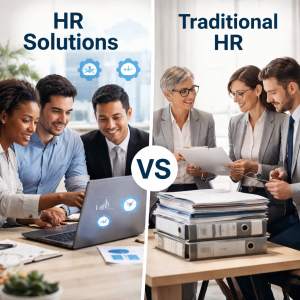
What Are Traditional HR Departments?
Traditional HR departments are in-house teams responsible for handling employee-related tasks and policies.
They typically manage:
- Hiring and onboarding
- Payroll coordination
- Benefits administration
- Employee records
- Basic compliance tasks
While this model works well for large, established companies, it often becomes expensive and rigid for growing organizations that need flexibility.
What Are HR Solutions and How Do They Work?
HR solutions are services provided by external specialists who manage HR responsibilities without requiring a full internal team.
These services often include:
- Compliance management
- Policy development
- Employee relations support
- Workforce planning
- HR strategy and advisory services
Unlike traditional HR departments, hr solutions scale with business needs and adapt as companies grow or change.
Schedule Free Consultation Now
How Do HR Solutions Differ From Traditional HR Departments?
The key difference lies in structure and flexibility.
Traditional HR departments:
- Require full-time staff
- Come with fixed costs
- Are limited by internal expertise
- Scale slowly
HR solutions:
- Offer on-demand expertise
- Reduce overhead
- Provide access to multiple specialists
- Scale up or down easily
For many businesses, HR solutions deliver broader expertise without long-term commitments.
Which Model Is More Cost-Effective for Growing Businesses?
Cost is one of the main reasons businesses reconsider traditional HR.
An internal HR department includes:
- Salaries and benefits
- Training and development
- HR software and tools
- Compliance risk exposure
HR solutions, on the other hand:
- Offer predictable pricing
- Reduce hiring and training costs
- Minimize compliance risks
- Deliver higher ROI for small and mid-sized companies
This is why many organizations now prefer working with HR service providers instead of building in-house teams.
How Do HR Solutions Handle Compliance Better?
Compliance is one of the most challenging aspects of HR.
HR solutions help businesses stay compliant by:
- Monitoring labor law changes
- Updating policies regularly
- Ensuring proper documentation
- Supporting audits and investigations
- Preventing classification and wage errors
Many hr outsourcing companies specialize in compliance management, making them better equipped to handle complex regulations than internal teams.
When Does a Traditional HR Department Make Sense?
Traditional HR departments may still be suitable when:
- A company has hundreds of employees
- HR needs are highly specialized
- There is a stable, predictable workforce
- Budget is not a major constraint
In these cases, in-house HR can provide consistency and deep internal knowledge.
When Are HR Solutions the Better Choice?
HR solutions are often the better option when:
- A company is scaling quickly
- Leadership lacks HR expertise
- Compliance risks are increasing
- Costs need to be controlled
- Flexibility is required
For startups and growing businesses, this model provides professional HR support without the burden of full-time staffing.
How Do HR Solutions Support Long-Term Business Growth?
HR solutions play a strategic role in growth by:
- Creating scalable HR systems
- Supporting leadership decision-making
- Improving employee engagement
- Reducing turnover
- Aligning HR with business objectives
Instead of reacting to problems, companies can plan proactively with expert guidance.
Why Do Businesses Choose Exceptional HR Solutions?
Exceptional HR Solutions works with organizations that need reliable, compliant, and scalable HR support without the cost of building a full HR department.
Their approach focuses on:
- Practical and compliant HR frameworks
- Scalable support tailored to growth
- Risk reduction and policy management
- Clear communication and ongoing guidance
Rather than offering generic services, Exceptional HR Solutions delivers customized HR support aligned with each business’s goals.
What Should Businesses Consider When Choosing HR Solutions?
Before selecting a provider, businesses should evaluate:
- Experience with similar-sized companies
- Knowledge of employment regulations
- Range of HR services offered
- Responsiveness and support model
- Long-term scalability
Choosing the right partner ensures HR becomes a strength rather than a liability.
Final Thoughts: Which HR Model Works Better Today?
For most growing businesses, modern hr solutions offer more flexibility, lower cost, and stronger compliance support than traditional HR departments.
By partnering with experienced hr outsourcing companies like Exceptional HR Solutions, businesses can focus on growth while ensuring HR responsibilities are handled professionally and efficiently.
The right HR model isn’t about size—it’s about choosing a structure that supports long-term success.
FREQUENTLY ASKED QUESTIONS
What are HR solutions used for?
HR solutions are used to manage employee compliance, policies, documentation, and workforce processes without maintaining a full in-house HR team. They help businesses reduce legal risk, improve HR structure, and operate more efficiently as they grow.
What is the difference between HR solutions and HR outsourcing companies?
HR solutions focus on strategic HR support, compliance, and workforce planning, while HR outsourcing companies usually handle administrative tasks like payroll or benefits. HR solutions provide long-term guidance rather than task-based services.
When should a company switch to HR solutions?
A company should switch to HR solutions when employee growth increases compliance risk, HR tasks become time-consuming, or managing policies internally becomes difficult. This often happens during expansion or multi-location hiring.
Are HR solutions better than hiring an in-house HR manager?
For many growing businesses, HR solutions are more cost-effective than hiring an in-house HR manager because they provide expert support without the overhead of full-time salaries, training, and compliance risk.
How do HR solutions reduce compliance risk?
HR solutions reduce compliance risk by keeping policies updated, ensuring legal documentation is accurate, and guiding businesses on employment regulations. This helps prevent costly mistakes, audits, and legal disputes.