
Common Payroll Mistakes Growing Companies Make and How Payroll Outsourcing Services Prevent Them
Payroll rarely fails because leaders are careless. It fails because growth quietly overwhelms systems that were never designed to scale.
In the early stages, payroll feels manageable. Headcount is small, pay structures are simple, and compliance feels predictable. As the business grows, that simplicity disappears. Hiring accelerates, pay types multiply, regulations expand across jurisdictions, and the margin for error shrinks. Payroll becomes one of the highest-risk operational functions in the company, often without leadership realizing it.
This guide breaks down the most common payroll mistakes growing companies make, why those mistakes increase with scale, and how payroll outsourcing services help prevent issues before they become costly problems.
What Are the Most Common Payroll Mistakes Growing Companies Make?
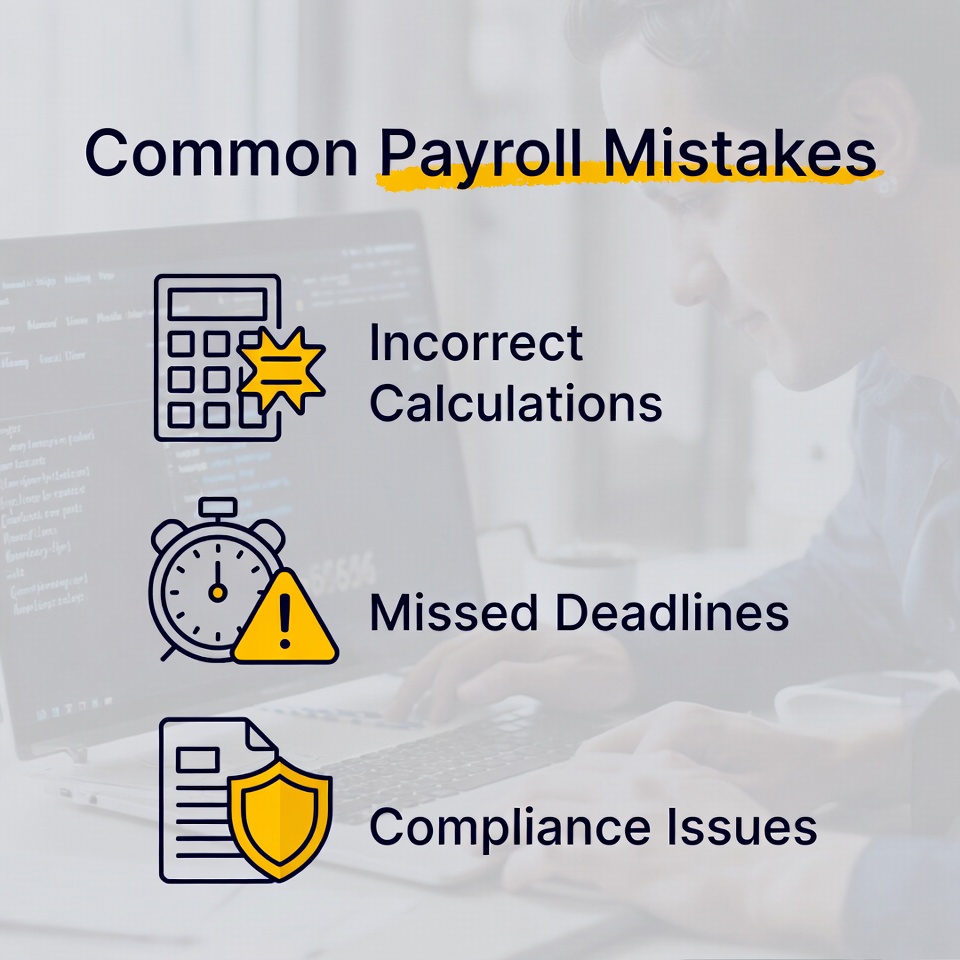
The most common payroll mistakes growing companies make include employee misclassification, payroll tax filing errors, manual calculation mistakes, inconsistent payroll processes, and delayed compliance updates. In many growing organizations, payroll outsourcing services function as part of broader hr outsourcing solutions, ensuring that compliance, reporting, and execution remain consistent as complexity increases.
Payroll mistakes tend to cluster around complexity. As companies grow, they introduce new variables faster than they update systems. Contractors are added quickly. Employees move across roles or states. Bonuses, commissions, overtime, and reimbursements appear. Each change adds risk.
Misclassification is one of the most frequent issues. Businesses often classify workers based on convenience or precedent rather than regulatory criteria. This creates exposure that may not surface until an audit or complaint occurs.
Tax filing errors are another major category. Missing deadlines, filing under incorrect jurisdictions, or using outdated rates can trigger penalties that compound over time. Even small discrepancies can escalate if left unresolved.
Manual payroll processes also create inconsistencies. Spreadsheets, disconnected systems, and ad hoc approvals increase the likelihood of errors, especially when volume rises. These mistakes erode employee trust and consume leadership time.
Individually, these issues may seem manageable. Collectively, they create systemic risk that grows with the company.
Why Do Payroll Errors Increase as Businesses Scale?
Payroll errors increase as businesses scale because administrative complexity grows faster than internal expertise, tools, and oversight.
Growth changes payroll in subtle but significant ways. A team of ten employees may be paid similarly, on the same schedule, under the same rules. A team of fifty introduces variability. A team of one hundred multiplies it.
Multiple pay structures, commissions, overtime eligibility, remote work arrangements, and multi-state employment introduce layers of compliance requirements. Each layer demands specialized knowledge and consistent execution.
At the same time, leadership focus shifts. Attention moves toward revenue, customers, hiring, and operations. Payroll becomes something that must “just work.” When it does not, the consequences feel disproportionate to the task itself.
Internal teams often rely on processes that worked previously, assuming they will continue to hold. The problem is not effort. It is that payroll does not scale linearly. Risk increases exponentially when systems lag behind growth.
How Do Employee Misclassification Errors Create Serious Payroll Risk?
Employee misclassification creates payroll risk by exposing companies to back wages, unpaid taxes, penalties, and regulatory audits.
Misclassification typically occurs when workers are labeled as contractors instead of employees, or when employees are incorrectly categorized as exempt from overtime. These decisions are often made quickly during growth to maintain flexibility.
The risk is not hypothetical. Regulatory agencies evaluate classification based on defined criteria, not intent. If a worker is misclassified, the company may owe back pay, taxes, interest, and penalties, sometimes going back several years.
Misclassification also affects benefits eligibility, unemployment insurance, and workers’ compensation coverage. These gaps often surface during disputes or audits, when correction becomes more expensive and public.
Growing companies are especially vulnerable because roles evolve quickly. A contractor may slowly take on employee-like responsibilities. An exempt role may become non-exempt due to shifting duties. Without consistent review, misclassification persists unnoticed.
What Causes Payroll Tax Filing Mistakes and Why Are They So Costly?
Payroll tax filing mistakes occur when deadlines, rates, or jurisdictional rules are missed, leading to penalties, interest, and increased regulatory scrutiny.
Payroll taxes involve multiple layers, federal, state, and often local. Each has its own filing requirements, deadlines, and calculation rules. As companies hire across states or regions, compliance obligations multiply.
Mistakes often stem from outdated information, incorrect jurisdiction assignments, or simple overload. A filing that is one day late can incur penalties. An incorrect rate can trigger notices that require investigation and correction.
What makes tax filing errors particularly costly is compounding. Penalties accumulate monthly. Interest continues to accrue. Notices consume administrative time and create anxiety for leadership.
Even when corrected, repeated issues can flag the organization for audits. At that point, payroll stops being an operational task and becomes a strategic distraction.
How Do Manual Payroll Processes Lead to Inconsistent and Incorrect Pay?
Manual payroll processes increase the likelihood of incorrect calculations, inconsistent pay, and delayed corrections as payroll volume and complexity increase.
Manual payroll systems rely heavily on human input. Spreadsheets, email approvals, and disconnected tools introduce friction and error points. As payroll volume grows, so does the chance of oversight.
Common issues include missed overtime, incorrect deductions, delayed reimbursements, or inconsistent bonus payments. Each error may seem small, but repeated issues erode employee confidence.
Employees may tolerate occasional mistakes early on. Over time, pay issues become a trust issue. Employees begin questioning accuracy and fairness, even if errors are unintentional.
For HR and finance teams, manual processes also consume disproportionate time. Fixing errors often takes longer than preventing them. This reactive cycle becomes unsustainable as the organization grows.
How Do Payroll Outsourcing Services Prevent Common Payroll Mistakes?
Payroll outsourcing services prevent common payroll mistakes by combining specialized expertise, automated systems, compliance monitoring, and consistent execution.
Payroll outsourcing services are designed around prevention, not correction. They use systems built to handle complexity, multiple pay types, jurisdictions, and regulatory updates without manual intervention.
Specialized expertise plays a critical role. Outsourced providers stay current with changing regulations, classification rules, and tax requirements. This reduces reliance on internal teams to track updates continuously.
Automation reduces human error. Calculations, filings, and reporting follow standardized workflows, lowering the risk of missed steps or inconsistencies. Documentation is maintained systematically rather than reactively.
Importantly, outsourcing does not remove visibility. Effective payroll outsourcing services provide transparency, reporting, and audit trails that allow internal teams to maintain oversight while offloading execution.
When Do Payroll Outsourcing Services Become the Right Move?
Payroll outsourcing services become the right move when payroll errors create stress, compliance questions increase, and leadership time is spent fixing issues rather than preventing them.
There is rarely a single trigger. Instead, patterns emerge. Corrections become frequent. Compliance questions take longer to answer. Payroll cycles feel tense rather than routine.
Employees may begin reporting pay issues more often. Leadership may hesitate before approving new compensation structures due to uncertainty. Internal teams may feel exposed when asked compliance questions they cannot answer confidently. At this stage, some organizations complement payroll outsourcing with fractional hr services, adding senior-level HR judgment to guide decisions that extend beyond accurate processing.
These signals indicate that payroll has outgrown informal systems. Outsourcing at this stage stabilizes operations before errors escalate into regulatory or trust issues.
The decision is less about company size and more about complexity. Some organizations reach this point at twenty employees. Others do not until one hundred. The common factor is strain.
How Should Businesses Evaluate Payroll Outsourcing Services Without Losing Control?
Businesses should evaluate payroll outsourcing services based on accuracy, compliance expertise, transparency, responsiveness, and alignment with internal HR ownership. In some cases, businesses also rely on a fractional hr consultant to provide experienced oversight, helping leadership interpret payroll data, assess risk, and align outsourced execution with internal people decisions.
Effective evaluation focuses on partnership, not delegation. Payroll outsourcing should strengthen internal control, not replace it.
Accuracy is foundational. Providers should demonstrate reliable execution across payroll cycles and jurisdictions. Compliance expertise should be proactive, not reactive.
Transparency matters. Clear reporting, accessible records, and defined escalation paths ensure internal teams remain informed. Responsiveness is critical when questions arise.
Finally, alignment with internal HR is essential. Payroll outsourcing services should integrate with existing HR processes, supporting leadership decisions rather than operating in isolation.
How Exceptional HR Solutions Can Help
If payroll is starting to feel risky, time-consuming, or harder to manage with confidence, Exceptional HR Solutions helps growing businesses stabilize payroll without overbuilding internal teams. If you want to assess whether your current payroll setup is creating hidden risk or holding your team back, a focused conversation with Exceptional HR Solutions can help you clarify next steps and determine the right level of support for where your business is today