
HR Outsourcing vs PEO vs Fractional HR: A Practical Decision Guide for Growing Businesses
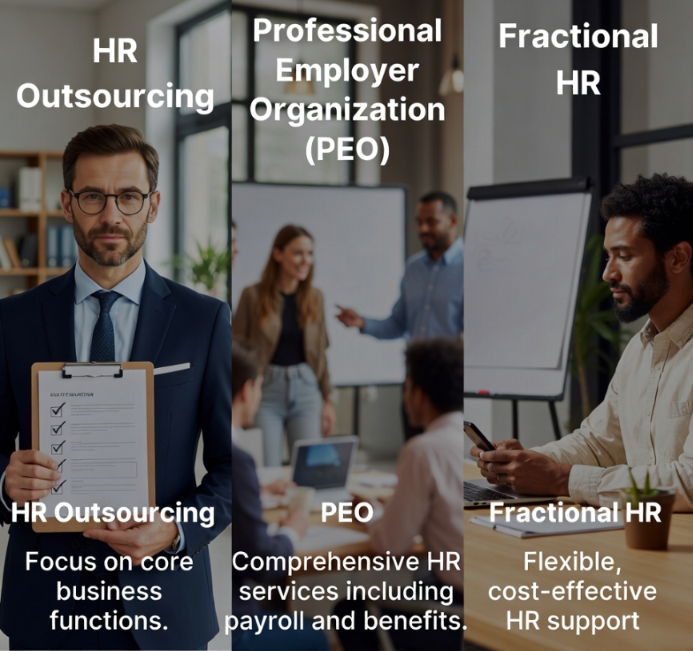
Growing a business almost always forces one uncomfortable realization. HR has become too complex to manage casually, but not complex enough to justify a full internal team. That tension pushes leaders toward three common options, HR outsourcing, PEOs, and fractional HR.
They sound similar. They are not.
This guide breaks down how each model works, when it makes sense, and how to choose without regret.
What is HR outsourcing, in simple terms?
HR outsourcing is when a business hires an external provider to handle specific HR tasks such as payroll, benefits administration, compliance filings, or employee documentation. The company keeps decision-making authority while delegating execution. It reduces administrative load but does not provide embedded leadership or ownership of people strategy.
Think of HR outsourcing as task relief. It helps when work volume increases but accountability and decision-making stay internal. For many teams, hr compliance solutions are the first outsourced layer because the penalties and downstream risk of getting filings, policies, or documentation wrong are disproportionately high. Many companies outsource payroll or compliance early because mistakes are costly and time-consuming.
Outsourcing works well when HR problems are operational, predictable, and well-defined. It struggles when issues become ambiguous, people-driven, or high-risk.
What is a PEO and how is it different from HR outsourcing?
A PEO, or Professional Employer Organization, enters a co-employment relationship with your company. The PEO becomes the employer of record for tax and benefits purposes, while you manage day-to-day work. This model centralizes payroll, benefits, and compliance but shifts significant control and responsibility away from the business. PEOs are often attractive for benefits access and compliance simplicity. However, co-employment introduces long-term contracts, limited flexibility, and shared liability structures that many founders underestimate.
A PEO is not just outsourcing tasks. It is restructuring how employment legally functions inside your company.
What is fractional HR and how does it actually work?
Fractional HR provides senior-level HR leadership on a part-time or embedded basis. Instead of outsourcing tasks, companies bring in experienced HR leaders who own strategy, decision-making, and risk management while integrating with leadership. The business retains control while gaining expertise without hiring a full-time executive.
Fractional HR is designed for complexity, not volume. It is most valuable when HR decisions affect culture, compliance exposure, leadership alignment, or growth strategy.
Unlike consultants, fractional HR leaders stay accountable over time and adapt as the company evolves.
When does HR outsourcing make the most sense?
HR outsourcing works best when HR needs are transactional, stable, and well-defined. This typically includes payroll processing, benefits administration, tax filings, and routine compliance tasks. It is ideal for small teams or companies with internal leadership that can confidently make HR decisions but lacks execution capacity. If your biggest HR pain is workload, outsourcing helps. If your biggest pain is judgment, risk, or escalation, outsourcing alone will fall short.
Outsourcing assumes someone inside the company knows what should be done and when.
When is a PEO the right choice for a growing business?
A PEO is best for early-stage or lean businesses that want bundled HR services, access to strong benefits, and simplified compliance without building internal HR systems. It works when flexibility is less important than convenience and when leaders are comfortable with co-employment and standardized processes. PEOs can feel like an instant HR department. The tradeoff is rigidity.
As companies grow, many discover that PEO structures limit customization, complicate leadership decisions, and create exit friction when needs change.
When does fractional HR become the best option?
Fractional HR becomes ideal when HR complexity outpaces internal experience, but a full-time hire is premature. This often occurs between 25 and 150 employees, during rapid growth, multi-state hiring, leadership transitions, or increased employee relations risk. Fractional HR provides strategic ownership without long-term overhead. This is the stage where mistakes become expensive. A misstep in termination, compliance, or culture can stall growth.
Fractional HR exists to prevent those mistakes while building systems that scale. That is why many growing teams explore fractional hr solutions as a way to get seasoned HR ownership without the cost or rigidity of a full-time hire.
How do these models differ in control and decision-making?
HR outsourcing keeps decisions internal but limits strategic support. PEOs reduce internal decision burden but also reduce control through co-employment. Fractional HR preserves full organizational control while embedding senior HR leadership into decision-making. The difference lies in who owns judgment, not who processes paperwork.
Control matters more as stakes rise.
If leaders want help executing decisions, outsourcing helps. If they want decisions made for them, PEOs step in. If they want expert guidance while staying in control, fractional HR fills that gap
How do costs really compare between HR outsourcing, PEOs, and fractional HR?
HR outsourcing is typically the lowest upfront cost but provides limited strategic value. PEOs bundle services into per-employee fees that grow with headcount and can become expensive over time. Fractional HR sits between, offering senior expertise at a predictable cost without full-time salary or long-term contract commitments.
What happens when a company outgrows its HR model?
Companies often outgrow HR outsourcing when decisions become complex and risky. They outgrow PEOs when flexibility, customization, or control becomes essential. Fractional HR is designed to evolve, either scaling up involvement or transitioning knowledge to internal hires, making it the least disruptive model over time.
What is the biggest mistake companies make when choosing an HR model?
The biggest mistake is choosing an HR model based on cost or convenience instead of accountability. Many companies underestimate how quickly HR decisions become strategic and risky. When no one clearly owns outcomes, issues compound quietly until they surface as turnover, compliance violations, or leadership burnout.
Which HR model is right for growing businesses today?
For growing businesses navigating complexity, fractional HR offers the most balanced approach. It combines leadership, flexibility, and cost control while preserving ownership and adaptability. HR outsourcing and PEOs still serve important roles, but fractional HR is often the most future-ready option for sustained growth.
How can Exceptional HR Solutions help companies choose and implement the right HR model?
Exceptional HR Solutions helps growing businesses evaluate whether HR outsourcing, a PEO, or fractional HR is the right fit for their stage and risk profile. By providing experienced fractional HR leadership, they support better people decisions, compliance clarity, and scalable HR systems without forcing long-term commitments or rigid structures.
Many companies do not struggle because they chose the wrong HR vendor, they struggle because no one owned the decisions behind HR. Exceptional HR Solutions works alongside leadership to bring structure, judgment, and continuity to HR, especially during periods of growth, transition, or complexity.
Instead of pushing a one-size-fits-all model, their approach helps businesses stabilize HR today while building toward what they will need tomorrow.
If you are evaluating HR outsourcing, considering a PEO, or wondering whether fractional HR makes sense, Exceptional HR Solutions helps clarify the path forward before costly mistakes are made.